The Operator's Operating System
Every operator runs on an operating system. Most of it is invisible, and almost none of it travels.
I learned this the slow way, across company after company where I was hired, more or less, to fix the same thing. The brief was always some version of the same sentence: we have a sales problem. Revenue is short, the forecast keeps slipping, the team is busy and the number still isn't there. Go fix sales.
From the top down, from the outside looking in, it always looked and smelled like a sales problem. The number was short, so the number was the problem, and sales owned the number. I believed that the first time. I did what you do — worked the pipeline, rebuilt the comp plan, tightened the talk tracks, coached the team. The numbers moved. They always moved. But "moved" was never quite enough to satisfy a goalpost that kept sliding, even in the years the totals ran into the hundreds of millions. Because the thing actually holding revenue back was rarely the thing standing on the sales floor.
By the third company I had stopped believing the brief on arrival, and I started counting instead. What I found is that there are more than eight reasons revenue doesn't close, and only one of them is sales.
The ICP drifts — the company keeps selling to the customer it had two years ago instead of the one it has now. The story stops matching the market; the words that used to land start bouncing, and nobody notices because they are too close to it. The comp plan rewards the wrong behavior, quietly paying people to do the opposite of the strategy on the slide. A product gap sits in the middle of every deal, absorbed by the field with their own credibility until they run out of it. Expectations get set from every angle — and not just misunderstood three layers down, but rarely built on reality in the first place. And what gets dismissed as "the team making excuses" turns out, often enough, to be the most accurate signal in the building. Nobody wanted to hear it, so it got labeled an excuse.
That was the hardest part, honestly. People rarely wanted to hear the truth, because their whole reality had been built on the assumption that it was a sales problem. The truth did not fit the story everyone had already agreed on.
Only one of those is a sales problem. The rest wear a sales problem's clothing because revenue is where the symptom shows up.

And underneath most of them, more often than any framework I could name, was something simpler and harder to fix with a system. People were not being led the way they needed to be led, and they were not being allowed to thrive. People are unique. The process was rigid — rigid to the point that we would run a perfect process at the expense of the actual person running it, and then call the person the problem. More than once, the fix was never a new model or a re-segmented pipeline. It was sitting down with one person and leading them, instead of correcting them.
Here is the part that took me longest to see. Every one of those companies was different. Different products, different stages, different people, different markets. The work was never the same twice. But the patterns underneath were nearly identical every time. The way you find the real problem behind the named one. The order you check things in. The tell that a pipeline number is lying. The instinct for when a yes is really a not-yet. The read on whether a team needs a new system or just needs to be led better.
Seeing those patterns over and over — company after company, and now engagement after engagement running my own fractional practice at itsjustrevenue.com — gave me a playbook I built and used to find the real problem, diagnose it, and fix it. Find, diagnose, fix. A different flavor of implementation every time. The same bones underneath.
That playbook is the most valuable thing I own as an operator. And it is almost entirely undocumented. You earn it by being wrong enough times to learn the tell, and it lives in exactly one place: your head.
Which means every time you leave, it leaves with you. The company keeps the CRM, the wiki, the dashboards, the documented process. You walk out with the part that actually mattered, and the company starts over with the next person. So do you, at the next engagement, rebuilding the same context by hand — relearning the ICP, re-diagnosing the comp plan, having the same "it's not really a sales problem" conversation you have had more times than you can count, from scratch.
I spent a year frustrated by that asymmetry before I understood what it actually was. Companies have spent two decades building knowledge bases for themselves. Nobody was building one for the person. The operator — the one carrying the transferable judgment from company to company — was the only party in the whole system with no durable memory of their own.
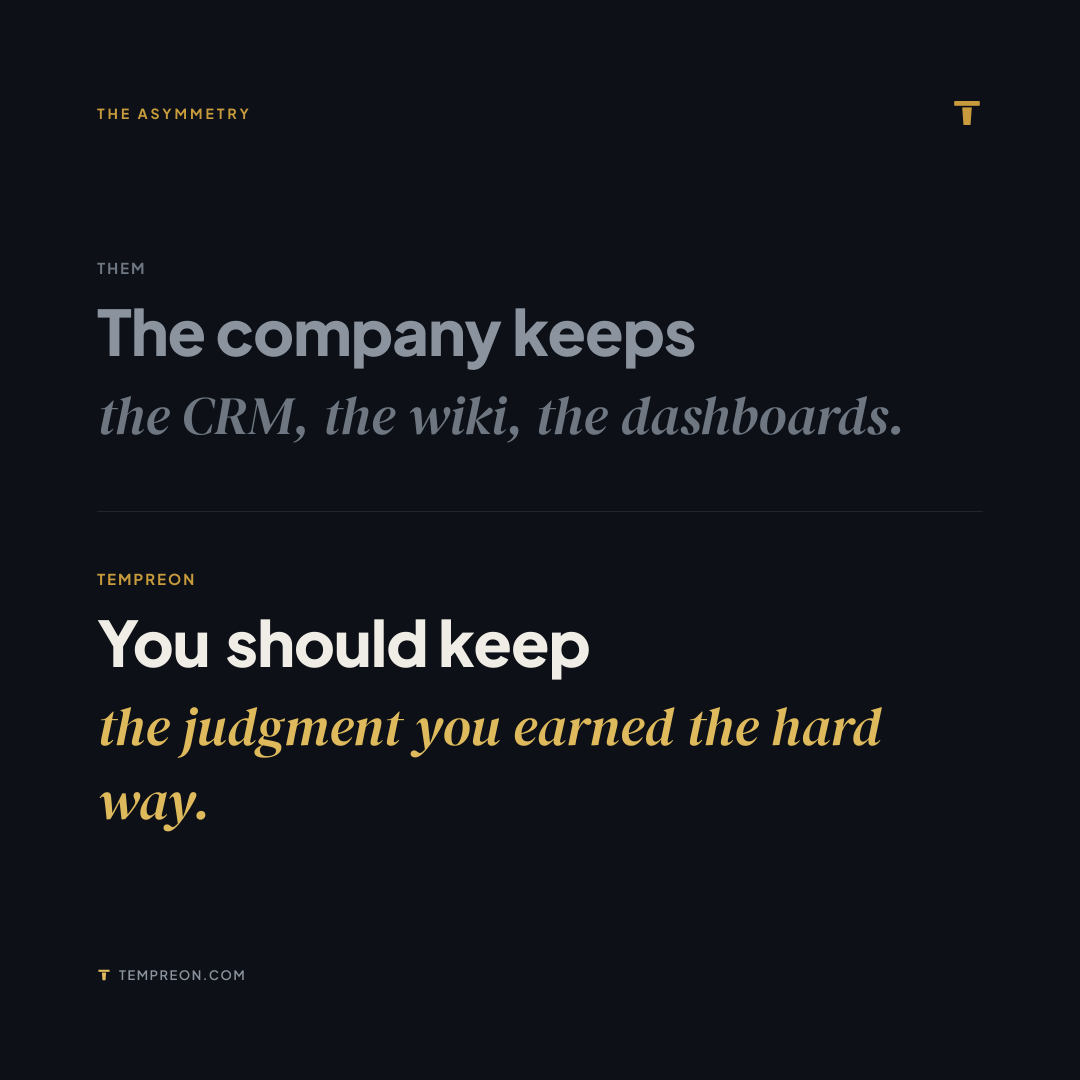
That is the gap Tempreon closes. And it is worth being precise about how, because most of the AI tooling aimed at this space is solving a different problem. The rest of the category wants to take what you have learned and hand it to everyone else — turn your judgment into someone else's feature. Tempreon does the opposite. It learns from you, and it builds on what makes you a better you, at scale.
And the stakes only get sharper. Some companies are now installing what amounts to spyware on their own people's machines — learning how they work, and then using what they learn to replace them. Sit with that for a second: your own judgment becomes the training data for your replacement. That is exactly why this has to be something you own. There has to be a layer that is yours — one your employer cannot take from you and your competition cannot copy — because it is you, and you are the one who should get to use it.
This is not memory in the shallow sense. Plenty of tools can store your chat history and call it memory. Storing what you said is a search problem, and it is mostly solved. The hard part is judgment — knowing what mattered, not just what happened. The difference between an assistant that can quote your last conversation back to you and one that understands the line you hold on discounting because it watched you hold it.
Tempreon captures the operating system underneath the work. Your Core Imprint — the voice, the frameworks, the principles you actually operate by. Decision Gates — your judgment, captured the moment you apply it, so the rule you enforced once becomes the rule your AI already knows next time. Your Network — not a contact list, but the texture of how you work with people, who you trust, whose introductions land. The instincts you have validated over years, made portable across every AI tool you already use, instead of resetting to zero in each one.
The work will keep changing. It always has. The next company will have a different product, a different stage, a different team, and the problem will arrive wearing the same disguise it always wears. That part I cannot change for you.
But the lessons that made you effective are yours. The patterns you earned the slow way should not have to be re-earned every time you change rooms. The company gets to keep its knowledge base. You should get to keep yours.
The work changes. The patterns don't. Neither should what you've learned.
Tempreon is live today, and there is a free tier to start. If you have been carrying your operating system around in your head, you can start keeping it instead.
— Brandon